
AI Beyond Tech: Slower Data Centers, Smarter Human Uses
When people talk about large language models, they usually mean code, chatbots and office productivity. But some of the most useful LLM work is happening far from tech: on small farms in Kenya and India, on construction sites, and in teams trying to cut carbon. Meanwhile, the race to build bigger models in bigger data centers is harming people and the environment, sometimes the very farmers the technology is supposed to help. Both things are true, and we still get to choose which one wins.
The bottleneck is information
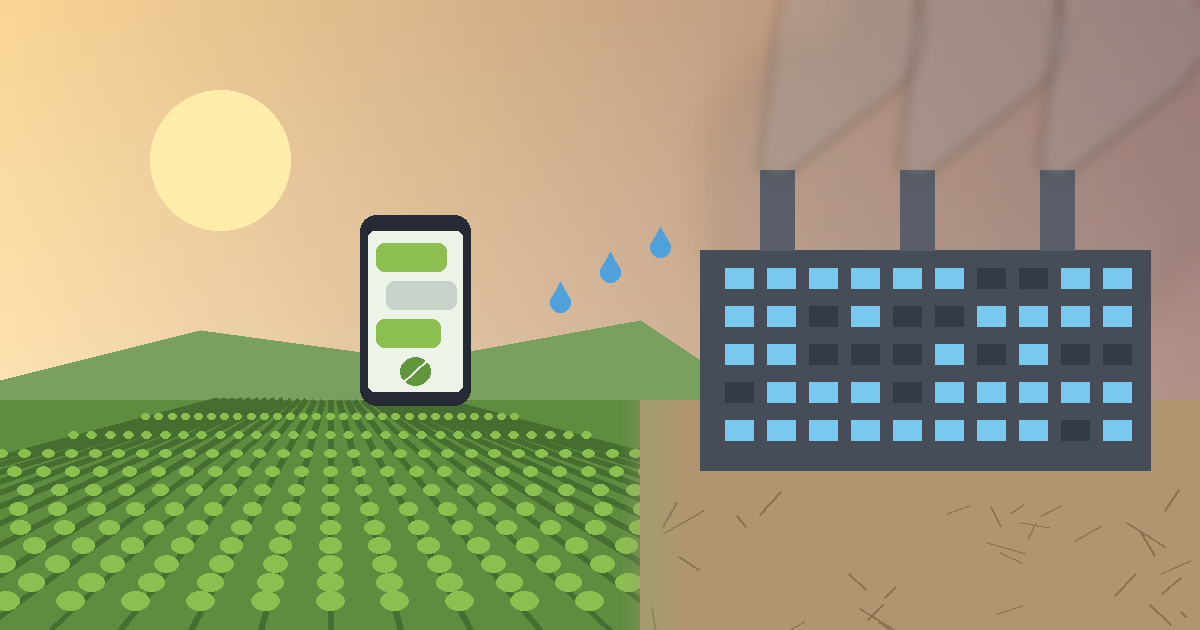
In a lot of agriculture, the bottleneck isn’t tractors or sensors. It’s getting the right information to the right farmer at the right time. A 2019 review in Science by Fabregas, Kremer and Schilbach found that advice sent by mobile phone in sub-Saharan Africa and India raised yields by about 4% and the odds of adopting recommended inputs by 22%. But Cole and Fernando’s randomized study of a voice advisory service for cotton farmers in Gujarat is a useful warning: farmers trusted it and changed their practices, yet yields and profits didn’t clearly improve.
LLMs add flexibility: a farmer can ask in their own language, by voice, with a photo of the leaf. That’s the idea behind FarmerChat from Digital Green (paper), which passed 1 million users across five countries in early 2026. In an independent 60 Decibels study, 7 in 10 Kenyan farmers applied its advice within 30 days.
The engineering lesson matters. GPT-4 passes agronomy certification exams, but Microsoft’s RAG vs Fine-tuning study found the real gains came from grounding models in local data. Digital Green fine-tuned on 25,000+ expert-reviewed Q&A pairs. Quality came from local knowledge and human experts, not a bigger model. A 2026 review still flags its one-way design, and a randomized trial across 600 Kenyan villages is now testing whether it moves yields and income. Good. That’s the evidence we should demand.
AI on the construction site
Construction rarely shows up in AI keynotes, but its footprint is huge. Catherine De Wolf of ETH Zurich points out that about half of the materials we consume go into buildings, which produce roughly a third of global waste. Her team uses AI to catalogue materials from buildings slated for demolition and match them with new projects. At UWE Bristol, ASPEC predicts embodied carbon at the planning stage, when changing materials is still cheap.
LLMs fit here for the same reason they fit on the farm: the work is mostly documents. Reading a 300-page spec to flag high-carbon choices, or turning a safety manual into something a crew will read, doesn’t need a frontier model. It needs accuracy, the right documents, and a low cost per run.
AI for sustainability work
Sustainability teams spend much of their time reading supplier reports and reconciling emissions data. For food companies, most of the footprint sits upstream on farms: fertilizer, land use, irrigation. Matching thousands of supplier sheets against farm data is tedious, text-heavy work, exactly where LLMs shine. They let a small team do what used to need a consultancy.
The race, and who pays for it
While farmers and builders find modest uses for AI, the biggest companies are racing to build ever larger models, and the bill lands on people who never signed up for it.
Energy. The IEA’s Energy and AI report projects data center electricity demand will more than double by 2030, to around 945 TWh, slightly more than Japan uses today. In the US, data processing is expected to use more electricity than aluminum, steel, cement and chemicals manufacturing combined. MIT researchers describe the industry as being on an unsustainable path.
Water. Here the farm and data center stories collide. Agriculture already accounts for around 70% of global freshwater withdrawals, and data centers now compete for the same water, often in dry regions. In Making AI Less “Thirsty”, Shaolei Ren and colleagues estimated that training GPT-3 could have evaporated about 700,000 liters of freshwater, and projected AI could account for 4.2 to 6.6 billion cubic meters of water withdrawal in 2027. Ren also notes that companies are secretive about their energy and water use. A farmer in a drought year can’t be secretive about water. Neither should a hyperscaler.
Air and health. A Caltech and UC Riverside study estimated that air pollution from AI’s power demand could cost the US nearly $20 billion a year in health damage by 2030, linked to around 1,300 premature deaths. The harm falls hardest on low-income communities near power plants and backup generators.
A real example. In South Memphis, xAI powered its Colossus supercomputer with gas turbines that, according to the Southern Environmental Law Center, ran without public notice or oversight. The county approved a permit for 15 turbines in July 2025 after months of opposition, and the NAACP appealed. This neighborhood has lived with industrial pollution for decades. Moving fast meant someone else breathing the exhaust.
Safety. In the Future of Life Institute’s Summer 2026 AI Safety Index, none of the nine companies graded scored above a C+, and the report found that companies have been weakening safety commitments as their models grow more capable.
Let’s be honest about what’s going on. AI companies are big corporations chasing money and power. That’s wild capitalism, and AI isn’t an exception. But I don’t think the technology itself is the problem. The internet gave us open knowledge and a way to stay close to family across the world. It also gave us surveillance, scams and misinformation. Same tech, very different outcomes. I believe AI is the same, and that we can point it at the good things. That’s what I’m working towards. As a tech enthusiast, I want to use technology for good.
What good looks like
The uses that actually help people don’t need any of that excess. Take diabetic retinopathy, a leading cause of blindness that’s easy to miss where eye specialists are scarce. Researchers in Bangalore tested Medios, an AI model that runs offline on the smartphone attached to a retinal camera. No cloud, no internet. It caught 98.8% of referable cases and 100% of vision-threatening ones according to the study in the Indian Journal of Ophthalmology. Or a farmer in Kenya getting a straight answer about fall armyworm in Swahili, on a cheap Android phone, over WhatsApp. An architect reusing steel beams instead of ordering new ones. An analyst finding the 20% of suppliers behind 80% of the emissions. Real wins for food and the planet, and all small, specific tasks.

AI is getting cheaper. So why the endless buildout?
Stanford’s 2025 AI Index found that the cost of querying a GPT-3.5-level model fell from $20 per million tokens in November 2022 to $0.07 by October 2024, a drop of more than 280 times.
And research says we can go further without bigger infrastructure. In Power Hungry Processing, Sasha Luccioni, Yacine Jernite and Emma Strubell found general-purpose generative models are orders of magnitude more expensive than task-specific ones for the same task. A UNESCO and UCL report showed that smaller task-specific models, shorter prompts and quantization could cut energy use by up to 90%. In 2026, UNESCO, France and India launched a global competition to compress models without losing performance. Ren’s group has shown that scheduling workloads during cooler hours reduces water lost to evaporation.
Put that next to the agriculture research and the picture is clear. What made agronomy answers better was local data and expert review, not scale. A farmer’s pest question is short, specific and repeated across thousands of farms. That’s the ideal workload for a small, grounded model, ideally one that runs on a phone with bad connectivity.
So who is the next hyperscale data center really for? Mostly the race to the next frontier model. Not the farmer. That’s why I think we should freeze the data center race:
- Pause new hyperscale AI data centers until companies must publicly report energy, water and air pollution per facility.
- Efficiency first. Default to the smallest model that does the job before asking for a new megawatt.
- Treat water as shared. Where farms already compete for irrigation, weigh a data center’s water use against agriculture and drinking water, in public, before approval.
- Give communities a real say, with a vote before construction and fair compensation for health costs.
Blockchain already showed it can be done
Crypto went through this same fight first. Bitcoin’s proof of work burns energy by design, and the Cambridge Centre for Alternative Finance estimates mining still uses about 138 TWh a year, around 0.5% of global electricity. Under pressure, the industry did shift: the same 2025 survey found 52.4% of miners’ energy now comes from renewables and nuclear, up from 37.6% in 2022, and coal fell from 36.6% to 8.9%. That’s real progress, though it’s a survey of the miners willing to answer, and total consumption kept rising.
Ethereum went further and changed the design itself. In September 2022, the Merge replaced mining with proof of stake, and the Crypto Carbon Ratings Institute estimated it cut the network’s electricity use by more than 99.98%, from about 23 million MWh a year to roughly 2,600. (The report was commissioned by ConsenSys, an Ethereum company, but the order of magnitude isn’t in dispute.)
The lesson for AI is direct: cleaner power helps, but the biggest wins come from changing the architecture. For Ethereum it was proof of stake. For AI, it’s smaller, task-specific models instead of one giant model for everything.
The honest counterargument
The IEA says data center emissions are small relative to the whole energy sector, and could be offset by reductions AI enables. Agriculture is a plausible place for that, if better advice means less wasted fertilizer and water. A freeze in one country might also just push construction somewhere with weaker rules.
AI on the farm isn’t risk-free either. In Nature Machine Intelligence, Asaf Tzachor and colleagues warned of unreliable data, models that optimize yield at the expense of soil and ecosystems, and security problems at scale. They suggest involving anthropologists and ecologists in design, data cooperatives so farmers own their data, and sandbox testing before rollout. Small models don’t fix that on their own.
And cheaper AI doesn’t automatically mean less energy. When something gets cheaper, we use more of it. That’s why I think efficiency alone isn’t enough and some limits are needed. It’s a real tension, and I’d rather name it than hide it.
Wrapping up
LLMs are already helping industries most of tech ignores, and the best examples are modest, specific and cheap. Decades of research on agricultural advice tell us what works: local knowledge, trusted delivery, and measuring whether farmers actually end up better off. None of that needs a bigger data center. The race for ever larger models is a different project, paid for in water, air and health by people who don’t get a say, including the farmers who need that water most. We have the research and the cheap models. So here’s my question: shouldn’t we stop chasing bigger models and focus on making LLMs use less energy, then put them to work where people actually live, in health, agriculture, education and the places most of tech still ignores?