
An Introduction to Edge Computing and Edge AI
Edge computing means running computation close to where data is produced, on a phone, a camera, a gateway in a barn, instead of shipping everything to a data center first. Edge AI is the same idea applied to machine learning: the model runs on (or next to) the device, so predictions happen in milliseconds, keep working offline, and don’t send raw data anywhere. This post covers the basics, the small models that make it practical in 2026, a quick look at agriculture, and where the research says things are going.
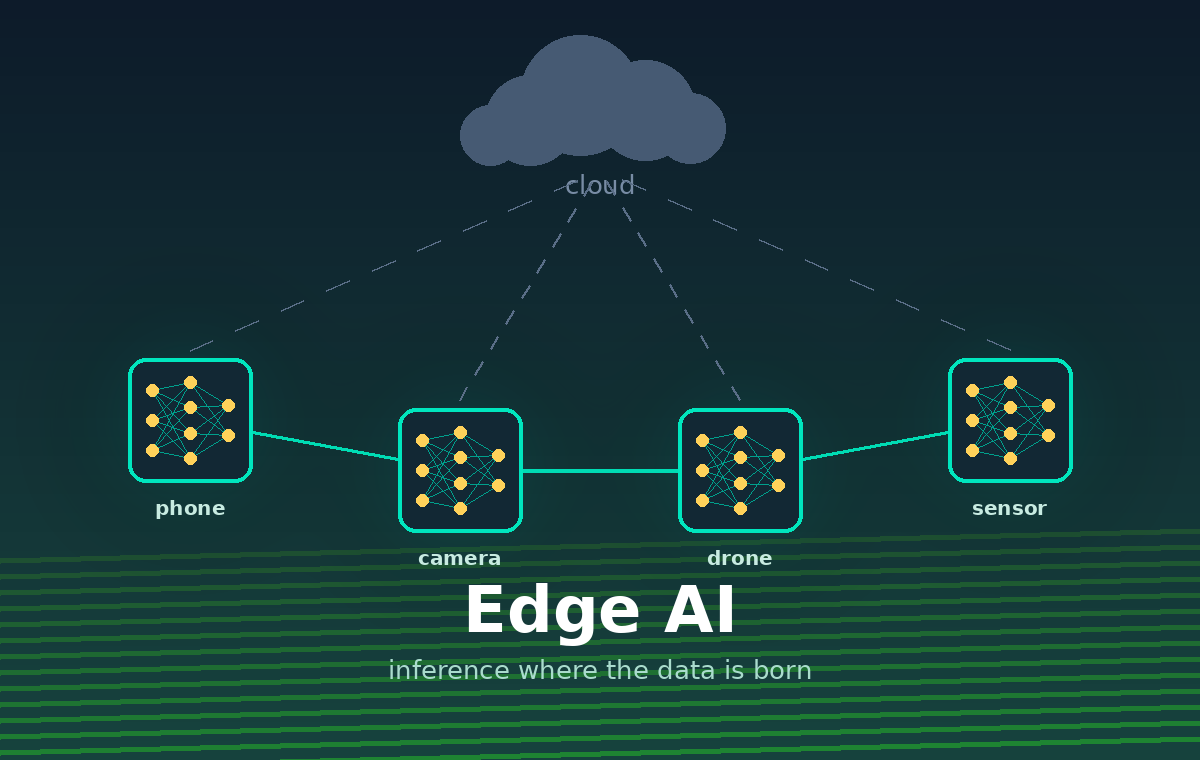
What edge computing actually is
The cloud model is simple: devices collect data, send it to a big data center, and wait for an answer. That works until it doesn’t. Bandwidth costs money, round trips add latency, and some places (a field, a ship, a mine) just don’t have a reliable connection.
Edge computing pushes part of that work back toward the source. Weisong Shi and colleagues framed it this way in Edge Computing: Vision and Challenges (IEEE IoT Journal, 2016), where the “edge” is any computing resource along the path between the data source and the cloud. Mahadev Satyanarayanan’s The Emergence of Edge Computing (IEEE Computer, 2017) adds the idea of cloudlets: small data centers one network hop away from users.
In practice there are a few layers:
- Device edge: phones, microcontrollers, cameras, drones, cars.
- Near edge: gateways, routers, an NVIDIA Jetson sitting in a shed.
- Far edge / regional: telecom edge servers and small regional data centers.
- Cloud: training, aggregation, anything heavy that isn’t time-sensitive.
You don’t pick one. Most real systems split the work across tiers.
From edge computing to Edge AI
Edge AI is what you get when the workload you’re moving closer to the data is model inference. Zhou et al. called it “the last mile of AI” in Edge Intelligence: Paving the Last Mile of Artificial Intelligence with Edge Computing (Proceedings of the IEEE, 2019), and the reasons they gave still hold:
- Latency. A crop-spraying drone can’t wait 400 ms for a server to say “that’s a weed”.
- Privacy. Audio, health data and photos never leave the device.
- Cost. No per-token API bill and much less upstream bandwidth.
- Availability. It keeps working with no signal.
The catch is obvious: devices have little memory, little power and slow memory bandwidth. So most of Edge AI is about making models smaller without making them dumb. The classic toolbox includes quantization, pruning and distillation (see Han et al.’s Deep Compression), plus newer LLM-specific tricks like activation-aware quantization (AWQ). Training can also stay distributed: federated learning lets devices improve a shared model without uploading their raw data.
The newest small models worth knowing
A couple of years ago “on-device LLM” mostly meant a demo. Now the open model hubs have a solid lineup sized for phones and single-board computers. A few I’d look at first on Hugging Face:
- Gemma 4 E2B / E4B (Google). The “E” stands for effective parameters (about 2.3B and 4.5B). They take text, image and audio input, have a 128K context, and ship as Apache 2.0. Google publishes ready-to-run builds for its on-device runtime in LiteRT-LM, and reports up to 2.2x faster decoding on mobile GPUs with multi-token prediction.
- SmolLM3 (Hugging Face). A fully open 3B model trained on 11T tokens, with the data and training recipe published. The SmolLM3 write-up is one of the best free explanations of how a small model gets trained.
- Phi-4-mini (Microsoft). Phi-4-mini-instruct is 3.8B, MIT licensed, strong at reasoning for its size. Phi-4-multimodal adds vision and speech.
- Others worth a look: Qwen3.5 (0.8B and 4B), Ministral 3, IBM Granite 4.0 Nano, Liquid AI’s LFM2.5 and Llama 3.2 1B/3B.
Phones also ship their own: Gemini Nano on Android and Apple’s Foundation Models framework on iOS. As an Android developer I find that part interesting, because it changes the question from “can I run a model here?” to “which one is already on the device?”.
If you want to try one on your laptop in a minute, llama.cpp can pull a quantized GGUF straight from Hugging Face:
llama-cli -hf ggml-org/gemma-3-1b-it-GGUF -p "Explain edge computing in one sentence."
One warning from recent research. The August 2026 study Large Models for Small Devices (Das et al.) measured compression on real hardware and found that no technique wins everywhere. Q5_K_M quantization held up well for question answering, while pruning hurt it badly. For image segmentation the ranking flipped. Pruning also broke k-quant block alignment, made files 21 to 49% bigger, and slowed a Raspberry Pi by up to 3.4x. They even found a compressed model with 71% accuracy that was putting 97 of 100 answers in the same class. So benchmark your model on your device, with your data. Paper numbers don’t transfer as well as we’d like.
A quick look at Edge AI in AgTech
Agriculture is probably the best argument for Edge AI. Farms are big, connectivity is bad, margins are thin, and decisions are time-sensitive.
Some places where it’s already useful:
- Plant disease detection from a phone photo, offline. This line of work goes back to datasets like PlantVillage, and today runs on MobileNet or EfficientNet-class models.
- Targeted spraying, where cameras on the boom tell crop from weed in real time and only spray weeds.
- Livestock monitoring with collar sensors and cameras that flag lameness or unusual behavior locally.
- Soil and irrigation sensors on microcontrollers that decide when to water without a server.
The March 2026 review Affordable Precision Agriculture by Samanta and Saha surveyed 2023 to 2026 work and found a few patterns. Most precision-ag systems still depend on the cloud, which shuts out smallholders. Cheap microcontrollers (ESP32, STM32) dominate the hardware. Quantization shows up in about half the papers, while pruning and hardware-aware architecture search are rarely tried. And most papers don’t report RAM, latency or energy, so it’s hard to compare anything. Their summary of the direction is “localized inference with centralized training”, which matches what I’d expect: train in the cloud, run in the field.
I wrote about the human side of this in AI Beyond Tech: farms and the data center race. Edge AI is the technical piece that makes a lot of those ideas affordable.
The future of Edge AI
So where is this going? The academic work points in a few directions, and they mostly agree.
Small models become the default, not the fallback. NVIDIA researchers argue in Small Language Models are the Future of Agentic AI (Belcak et al., 2025) that most agent sub-tasks are narrow and repetitive, so a small model is good enough and much cheaper. Large models get called only when needed. That fits the edge perfectly.
Agents move onto devices. The survey Cognitive Edge Computing looks at how reasoning models and autonomous agents can run on constrained hardware, and the broader Empowering Edge Intelligence survey (later in ACM Computing Surveys) covers the on-device model landscape and its open problems.
The network becomes part of the model. Network Edge Inference for Large Language Models (2026) argues that the design problem is shifting from “fit everything on one device” to co-designing model, memory, compute and communication across device, edge server and cloud. Think split inference, speculative decoding with a small draft model on the phone, and KV caches that live on a nearby server.
Measurement gets serious. Das et al. call for tools that profile prefill and decode separately and recommend a configuration per device. Benchmarks like MLPerf Tiny started this for microcontrollers. LLMs on phones need the same discipline, because memory bandwidth, not FLOPs, is usually what limits you.
My own take: the cloud isn’t going away, it’s just becoming the place where models are trained and where the hard 10% of requests go. The other 90% (classify this leaf, summarize this note, answer this simple question) will happen on hardware you already own. For mobile developers that’s good news. On-device AI is turning into a normal part of the app, like camera or location, and the people who understand memory, battery and latency on real devices are going to be useful for a long time.
References
- Shi et al., Edge Computing: Vision and Challenges, IEEE IoT Journal, 2016
- Satyanarayanan, The Emergence of Edge Computing, IEEE Computer, 2017
- Zhou et al., Edge Intelligence: Paving the Last Mile of AI with Edge Computing, 2019
- Das et al., Large Models for Small Devices, arXiv, 2026
- Samanta and Saha, Affordable Precision Agriculture, arXiv, 2026
- Belcak et al., Small Language Models are the Future of Agentic AI, arXiv, 2025
- Network Edge Inference for Large Language Models, arXiv, 2026
- Hugging Face, SmolLM3: smol, multilingual, long-context reasoner
- Google AI Edge, Gemma 4 on LiteRT-LM